
- Home
- About the Expert
- Areas of Expertise
- Slip & Fall Hazard Analysis
- Trip & Fall Hazard Analysis
- Walking-Surface & Floor Traction
- Wet-Floor & Moisture Hazards
- Maintenance Standard of Care
- Warnings, Matting & Lighting
- ADA & Building-Code Walking Surfaces
- Occupied-Facility Safety
- Construction Defects & Walking Surfaces
- Forensic Inspection & Testimony
- ASTM F1637 Guide
- Testimony Experience
- Download CV
- Contact
- Home
- About the Expert
- Areas of Expertise
- Slip & Fall Hazard Analysis
- Trip & Fall Hazard Analysis
- Walking-Surface & Floor Traction
- Wet-Floor & Moisture Hazards
- Maintenance Standard of Care
- Warnings, Matting & Lighting
- ADA & Building-Code Walking Surfaces
- Occupied-Facility Safety
- Construction Defects & Walking Surfaces
- Forensic Inspection & Testimony
- ASTM F1637 Guide
- Testimony Experience
- Download CV
- Contact

About this area of expertise
Trip and fall analysis is dimensional. Changes in level, thresholds, stair riser and tread consistency, nosing condition and handrail geometry are measured on site and compared against the limits published in the applicable code and in ASTM F1637.
Dimensional defects rarely appear overnight. Settlement, wear and progressive damage develop across months or years, which puts the inspection and repair record at the centre of establishing how long a condition existed and whether it should have been found.
What this analysis covers
Dimensional defects rarely appear overnight. Settlement, wear and progressive damage develop across months or years, which puts the inspection and repair record at the centre of establishing how long a condition existed and whether it should have been found.
- Change-in-level measurement at transitions
- Threshold and saddle installation review
- Stair riser, tread and nosing consistency checks
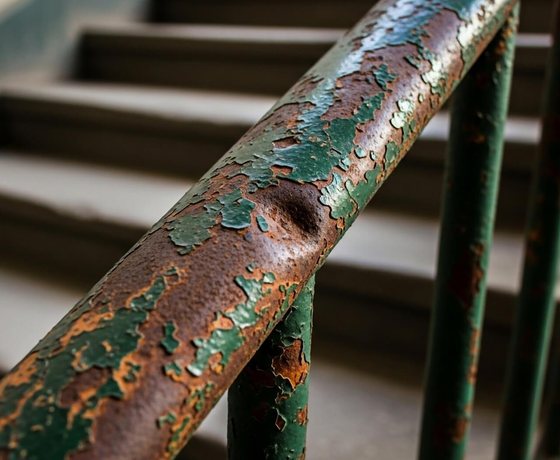
- Handrail height, continuity and graspability
- Sidewalk settlement and joint differential survey
Frequently Asked Questions
Common questions counsel and adjusters ask about trip-and-fall and change-of-level analysis in Chicago and Cook County.
ASTM F1637 addresses abrupt changes in level and the point at which one requires bevelling or a ramped transition. The building code and accessible-route requirements carry their own limits. The as-found dimension is measured and compared to whichever governs that location, not to a rule of thumb.
Yes, because people climb on rhythm rather than by looking at each tread. A riser differing from the others interrupts that rhythm at the moment the foot is committed. Dimensions are measured across the whole flight, since the variance between treads is the condition that matters.
It goes to whether a fall that began for another reason could have been arrested. Height, continuity, graspability and extension past the top and bottom risers are all measurable against the code in force. The opinion addresses the physical non-compliance, not the mechanics of the descent.
The same way as interior surfaces. The differential at the joint is measured, surrounding sections are examined for the settlement or heave pattern that produced it, and the result is compared to the standard and to the owner's own inspection and repair practice.
It can. A curled or rippled edge, a mat too thick for its location without a bevelled border, or one that shifts under traffic creates exactly the abrupt edge it was meant to remove. Mat type, backing, condition and placement are assessed against the traffic it serves.
Dimensional defects develop over months or years, so the repair record carries the weight: work orders, punch lists from a prior renovation, photographs taken for unrelated purposes, and the maintenance schedule for the area. Together they show when the condition became findable.
Areas of Expertise
Request a consultation
Service Area
Chicago & Cook County